Related Articles in This Series
- The Hidden Reason Beginners Struggle With Affiliate Conversions
- Why Affiliate Marketing Is About More Than Just Getting Clicks
- Why I Stopped Chasing Immediate Affiliate Clicks
- Why Traffic Alone Didn’t Fix My Affiliate Marketing Problem
- Why Beginners Often Fear Data in Affiliate Marketing
- How Building Trust Creates Better Affiliate Conversions
- What My Zero-Click Days Were Actually Teaching Me
- The First Time My Email Sequence Generated a Real Click
- What Affiliate Marketing Actually Means After the Hype Fades
Many affiliate marketers spend most of their time trying to improve traffic.
They test headlines, experiment with ads, chase keywords, and optimise click-through rates.
Those things matter.
But there is another factor that quietly influences almost every conversion decision online:
Trust.
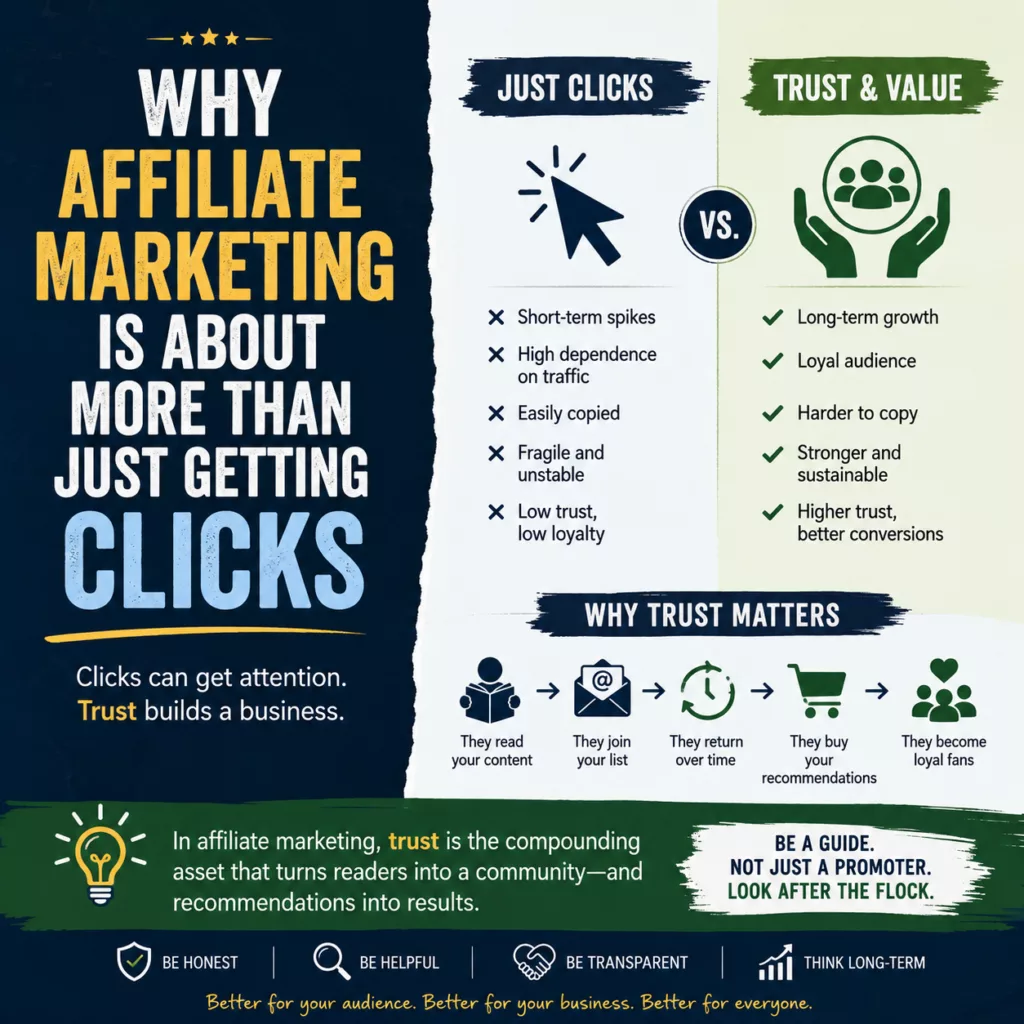
Without trust, even strong traffic can struggle to convert.
With trust, even smaller audiences can produce surprisingly strong results.
That’s because affiliate conversions are not only technical events.
They are psychological decisions.
People Rarely Buy Instantly
One of the biggest misconceptions in affiliate marketing is the idea that people immediately buy the moment they see a recommendation.
Sometimes that happens.
But most of the time, people are evaluating more than the product itself.
They are evaluating:
- the person making the recommendation,
- the tone of the content,
- the honesty of the explanation,
- and whether the recommendation feels genuine or forced.
That evaluation process is trust formation.
And it heavily influences whether conversions happen later.
Trust Reduces Friction
Every affiliate recommendation contains uncertainty.
Readers naturally wonder:
- Is this product actually useful?
- Is this person exaggerating?
- Is this recommendation only about commissions?
- Will this help me or waste my time?
Trust reduces that uncertainty.
When readers believe you are being honest, transparent, and thoughtful, the recommendation feels safer.
That does not guarantee a conversion.
But it lowers resistance.
And lower resistance usually improves conversion rates over time.
Helpful Content Builds Credibility
Many affiliate sites focus almost entirely on promotion.
But readers usually trust helpfulness more than hype.
When your content:
- explains things clearly,
- acknowledges limitations,
- shares genuine observations,
- and helps readers think more carefully,
your recommendations begin carrying more weight.
Readers start viewing you as:
- useful,
- informed,
- and credible.
That credibility compounds across multiple posts.
Trust Often Builds Before the Recommendation Appears
Affiliate marketers sometimes focus too narrowly on buttons and calls to action.
But conversion psychology usually begins much earlier.
Trust can be influenced by:
- the quality of the introduction,
- the clarity of the writing,
- the honesty of the tone,
- the structure of the explanation,
- and whether readers feel respected.
Long before someone reaches an affiliate link, they are already deciding:
“Do I trust this person enough to take their recommendation seriously?”
That silent decision shapes conversions more than many beginners realise.
Returning Readers Convert Differently
One-time visitors behave differently from returning readers.
Returning readers already understand your style, tone, and philosophy.
They are more familiar with your approach.
That familiarity lowers uncertainty.
And lower uncertainty often increases:
- engagement,
- email signups,
- affiliate clicks,
- and long-term conversion potential.
This is one reason trust-focused affiliate businesses can become surprisingly durable over time.
Why Manipulation Usually Fails Long-Term
Short-term tricks can sometimes produce temporary results.
Aggressive headlines.
False urgency.
Overhyped promises.
Pressure tactics.
But these strategies often damage trust.
And once trust erodes, conversions become harder to sustain.
Readers become skeptical.
Returning traffic weakens.
Email engagement drops.
Long-term momentum fades.
That is why sustainable affiliate marketing usually depends more on credibility than manipulation.
Trust Compounds Quietly
One of the interesting things about trust is that it compounds slowly and often invisibly.
A reader may:
- read several articles,
- observe your consistency,
- watch how you explain things,
- and return multiple times before ever clicking a recommendation.
But when trust finally forms, conversions often become more natural.
The recommendation no longer feels like a random promotion.
It feels like guidance.
That changes the entire dynamic of affiliate marketing.
Final Thoughts
Affiliate conversions are not created by clicks alone.
They are shaped by perception, credibility, familiarity, and trust.
Traffic matters.
But trust changes how people interpret your recommendations.
And over time, that trust can become one of the strongest conversion assets an affiliate marketer can build.
Want to follow the experiment as it develops?
Ready to Start Your Own Affiliate Marketing Journey?
I’m documenting my own affiliate marketing experiment in real time using the platform below.
Start Your Free Affiliate Journey →
No credit card required. Free starter membership available.