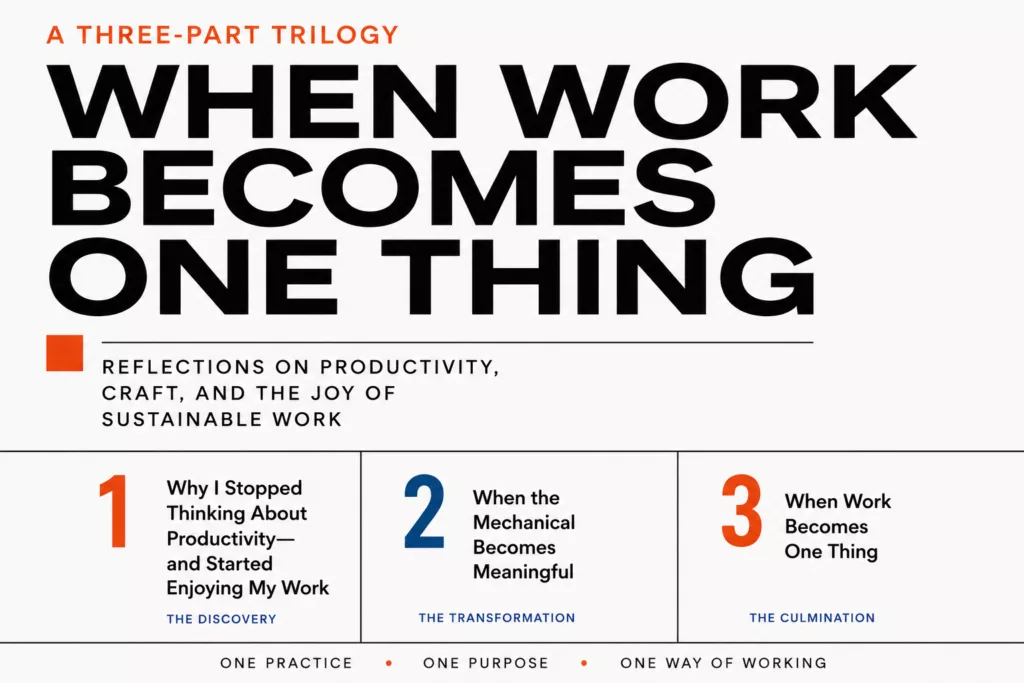
Part 3 of When Work Becomes One Thing trilogy
Looking back over that day, I realised something else had happened.
It wasn’t simply that I had become more productive.
Nor was it simply that the repetitive parts of the work had become enjoyable.
The deeper change was that I had stopped experiencing them as separate activities altogether.
Writing.
Editing.
Generating images.
Installing them in WordPress.
Creating slugs.
Updating the series lists.
Adding the Mailchimp and Wealthy Affiliate blocks.
Updating the publication calendar.
From the outside, those are clearly different tasks.
From the inside, they had quietly become one continuous activity.
That surprised me more than anything else.
Perhaps that’s what people are trying to describe when they speak about being “in the flow.”
We often imagine flow as an extraordinary state that arrives without warning.
Something mysterious.
Something almost accidental.
My own experience has led me to a rather different conclusion.
Flow wasn’t something I found.
It found me.
Not because I chased it.
Because I gradually built a way of working in which each stage naturally led to the next.
The workflow had quietly become a flow.
That distinction matters.
One belongs to the external world.
The other belongs to our lived experience.
When those two rhythms begin to align, something remarkable happens.
The internal and the external cease to feel like opposites.
They become a continuum.
One of the simplest examples occurred to me while I was writing these articles.
We often think of writing and typing as two different activities.
Writing is creative.
Typing is mechanical.
Yet every writer knows there are moments when those distinctions disappear.
The fingers seem to think.
The keyboard no longer feels like a machine.
It becomes part of the thinking itself.
In front of the keyboard, a writer is rather like a violinist in front of a violin.
The instrument isn’t an obstacle standing between the musician and the music.
It’s the means through which the music comes into being.
Perhaps the same is true of every mature craft.
Technique doesn’t compete with expression.
Technique makes expression possible.
Looking back, I realise that something similar happened throughout my publishing workflow.
The WordPress editor.
The graphics.
The HTML blocks.
The series lists.
The publication calendar.
None of them interrupted the creative process.
They had quietly become part of it.
The production line hadn’t disappeared.
It had become a practice.
That may be the most important lesson I learned that day.
Not because it made me more productive.
But because it changed my relationship with the work itself.
I no longer felt as though I were moving between thinking and doing.
The thinking had become a way of doing.
The doing had become a way of thinking.
Perhaps that is what craftsmanship feels like.
Not the disappearance of effort.
But the disappearance of fragmentation.
You know you’ve arrived at a certain point in your work when all those separate activities suddenly appear as one single activity.
That doesn’t mean every day will feel this way.
Mine certainly don’t.
But having experienced it once, I now know what I’m trying to cultivate.
Not productivity.
Not efficiency.
Not even flow itself.
A way of working that quietly allows those things to emerge.
Reflection
If these reflections have led you to ask not simply how you can produce more, but how you can sustain yourself—day by day, year by year—then I’ll consider my efforts well rewarded.
Because the greatest discovery I made wasn’t that I could accomplish more than I had imagined.
It was that good work can become a place in which we genuinely enjoy dwelling.
And perhaps that’s what makes it possible to return again tomorrow.
Want to follow the experiment as it develops?
Ready to Start Your Own Affiliate Marketing Journey?
I’m documenting my own affiliate marketing experiment in real time using the platform below.
Start Your Free Affiliate Journey →
No credit card required. Free starter membership available.