
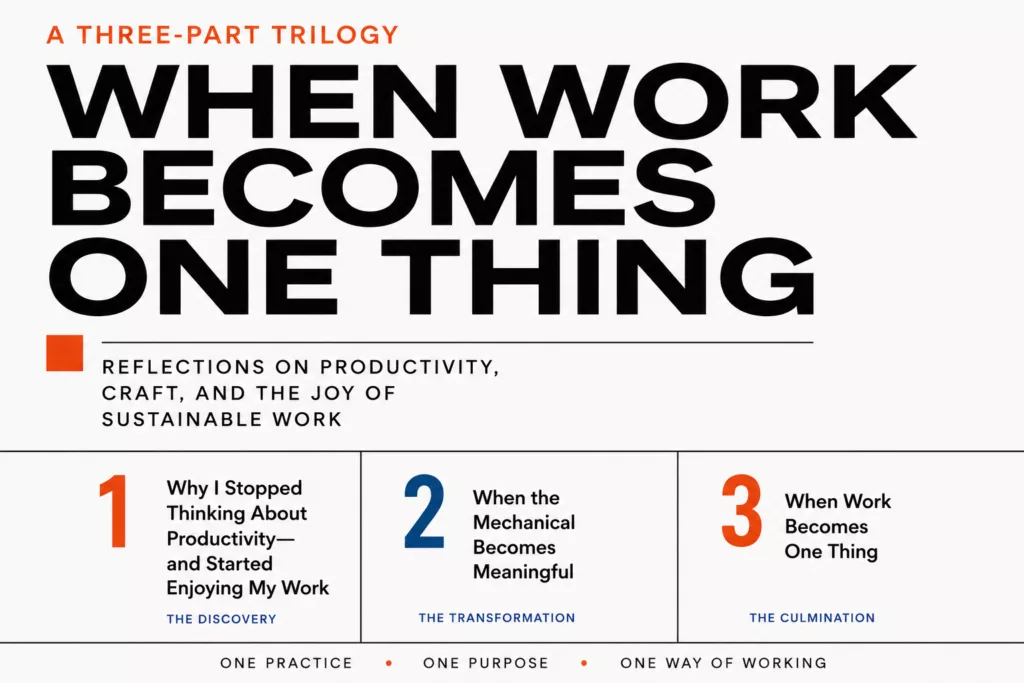
Part 2 of When Work Becomes One Thing trilogy
Most of us divide our work into two categories.
There is the creative work.
And then there is everything else.
Writing belongs to the first category.
Installing images.
Updating WordPress.
Creating slugs.
Adding HTML blocks.
Checking links.
Those belong to the second.
At least, that’s how I used to think about them.
The first felt meaningful.
The second felt necessary.
During the same working session I wrote about in the previous article, something rather unexpected happened.
Those distinctions slowly began to disappear.
After drafting an article, I would move almost instinctively to the next stage.
Generate the image.
Install it.
Write the Alt Text.
Add the title.
Paste the series list.
Install the Mailchimp block.
Install the Wealthy Affiliate block.
Move to the next article.
Then repeat.
Objectively, nothing had changed.
The tasks were exactly the same as they had always been.
Subjectively, however, everything had changed.
None of those activities felt like interruptions any longer.
They felt like the natural continuation of the writing itself.
That surprised me.
For years, I’ve heard people use the word mechanical almost as a criticism.
Mechanical work is supposed to be the work we endure so that we can return to the creative part.
Yet that wasn’t what I experienced.
The mechanics hadn’t disappeared.
They had become meaningful.
It suddenly occurred to me that writing and typing provide a simple example.
We often imagine that writing is the creative act while typing is merely the mechanical implementation.
Yet anyone who has become deeply absorbed in writing knows that those two activities eventually merge.
You stop thinking,
“I’ve finished writing. Now I must type.”
Instead, the typing becomes part of the thinking.
The keyboard no longer feels like an obstacle between the mind and the page.
It becomes the medium through which the ideas continue to develop.
The same thing seemed to happen throughout the entire publishing process.
Drafting the article.
Installing the image.
Checking the HTML.
Updating the publication calendar.
None of those felt like separate jobs competing for my attention.
They felt like different movements within the same piece of work.
That may explain why the day felt unusually satisfying.
I wasn’t constantly switching between creative mode and administrative mode.
There was only one mode.
The work itself.
Perhaps that’s one of the quiet characteristics of craftsmanship.
The repetitive actions never disappear.
Instead, they gradually become integrated into a practice that feels coherent and internally rewarding.
Flow, I began to realise, doesn’t eliminate the mechanical.
It integrates it.
Reflection
We often imagine that enjoyment begins when the repetitive work finally ends.
My experience has been almost the opposite.
Sometimes the repetitive work becomes enjoyable because it no longer feels separate from the creative work.
It becomes another way of participating in the same act of creation.
Next in this series
When Work Becomes One Thing
How the boundary between thinking and doing quietly disappeared—and why that changed the way I now understand work itself.
Want to follow the experiment as it develops?
Ready to Start Your Own Affiliate Marketing Journey?
I’m documenting my own affiliate marketing experiment in real time using the platform below.
Start Your Free Affiliate Journey →
No credit card required. Free starter membership available.