Series: Why Human Experience Is Becoming More Valuable Online
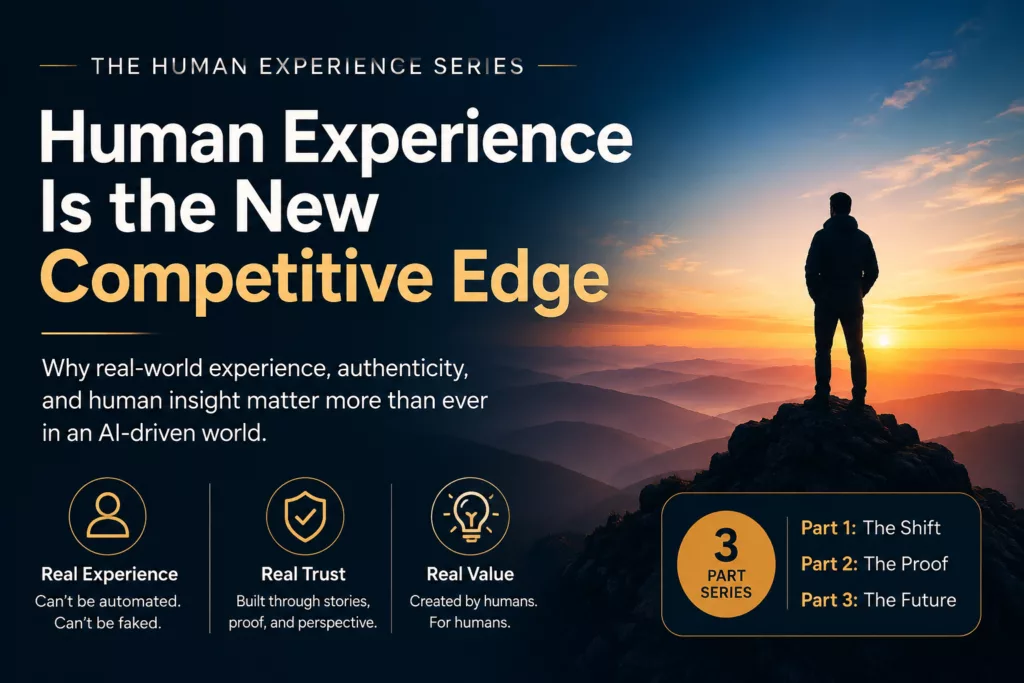
This article is Part 2 of a 3-part series exploring why genuine human experience is becoming more valuable in an age increasingly shaped by AI and search algorithms.
- Why Human Experience Is Becoming More Valuable Online
- How Google Quietly Changed the Rules of the Internet
- Why AI Will Make Real Writing More Valuable (Not Less)
For many years, ranking well in search engines was often viewed as a technical challenge.
Choose the right keywords.
Optimise your headings.
Build backlinks.
Improve site speed.
While these factors still matter, Google’s evaluation of content has evolved considerably.
Increasingly, Google appears to be rewarding something that is much harder to manufacture:
Real-world experience.
This shift is often discussed under the concept of EEAT:
Experience, Expertise, Authoritativeness, and Trustworthiness.
Of those four elements, one stands out because it is uniquely difficult to fake.
Experience.
The Rise of Experience
Historically, a well-written article could often compete regardless of whether the author had personally experienced the topic.
Today, that appears to be changing.
Google’s quality guidance repeatedly emphasises the importance of first-hand experience.
The search engine is not simply asking:
“Is this information accurate?”
It is increasingly asking:
“Has this person actually done the thing they are writing about?”
That distinction matters.
A person who has read about affiliate marketing possesses information.
A person who has run campaigns, tracked conversions, built websites, and analysed results possesses experience.
Those are not the same thing.
Why Experience Is Difficult To Replicate
Experience leaves traces.
It produces observations that are rarely found in generic content.
It creates lessons that emerge only after encountering real-world problems.
For example, someone who has actually run advertising campaigns understands that traffic and conversions rarely move in perfect harmony.
Someone who has built an email list understands that subscriber behaviour is often unpredictable.
Someone who has published content consistently understands that growth rarely follows a straight line.
These observations are difficult to generate from theory alone.
They emerge from participation.
The Limits Of Generic Content
The internet now contains an extraordinary amount of information.
Much of it is accurate.
Much of it is useful.
But much of it is also interchangeable.
Readers increasingly encounter articles that provide similar advice, use similar examples, and arrive at similar conclusions.
As content becomes more abundant, originality often comes from experience rather than information.
This may explain why personal case studies, documented experiments, and first-hand observations continue to attract attention.
They offer something that generic summaries cannot.
Evidence.
What This Means For Content Creators
For content creators, this trend creates both a challenge and an opportunity.
The challenge is obvious.
Publishing generic information alone may become increasingly difficult as AI tools make content production easier.
The opportunity is equally clear.
Every creator possesses experiences that nobody else can replicate.
Your results.
Your failures.
Your observations.
Your lessons.
These are forms of evidence.
They demonstrate that the content is grounded in reality rather than theory alone.
Why Trust Matters
Ultimately, Google’s focus on experience is closely connected to trust.
Readers want reliable information.
Google wants to deliver reliable information.
Real-world experience often provides one of the strongest signals that information has been tested rather than merely repeated.
That does not guarantee accuracy.
Experience can still be flawed.
But it offers a level of credibility that purely theoretical content often lacks.
Final Thoughts
As AI continues to transform content creation, the value of real-world proof may continue to rise.
Information is becoming easier to generate.
Experience is not.
Google’s increasing emphasis on EEAT suggests that genuine experience, documented results, and first-hand observations may become some of the most valuable assets a creator can possess.
In a world overflowing with information, proof may become one of the strongest forms of differentiation.
Want to follow the experiment as it develops?
Ready to Start Your Own Affiliate Marketing Journey?
I’m documenting my own affiliate marketing experiment in real time using the platform below.
Start Your Free Affiliate Journey →
No credit card required. Free starter membership available.