
In this series:
- Why Mechanical Work Makes Me Think
- The False Divide Between Thinking and Doing
- When Repetition Opens the Window
Something happens after I’ve been doing the same kind of work for a while.
The procedure becomes familiar.
My hands seem to know what comes next.
The immediate decisions diminish.
And then, occasionally, a window opens.
A thought appears that I wasn’t looking for.
In the first article in this trilogy, I described how mechanical work seems to make me think.
In the second, I questioned the traditional hierarchy that places doing beneath thinking.
Now I want to stay with the strangest part of the experience:
Why does repetition sometimes seem to create the conditions for something completely new to appear?
The Paradox of Repetition
Repetition sounds like the enemy of novelty.
Do the same thing again.
Then again.
Then again.
Nothing could appear less creative.
Yet my experience suggests almost the reverse.
Once the repetitive part of an activity becomes sufficiently familiar, I no longer have to devote the same attention to controlling every step.
The task continues.
But something in my mind seems to loosen.
That’s when the unexpected thought can arrive.
So the paradox is:
repetition may sometimes create the space in which novelty becomes possible.
The Rhythm Comes First
I’ve noticed that there is usually a rhythm before there is an insight.
This installation exercise is a perfect example.
Post.
Series list.
Slug.
Category.
Graphic.
Alt text.
CTAs.
Then begin again.
At first, the sequence requires conscious attention.
After enough repetition, however, it develops momentum.
I know where I am.
I know what comes next.
The procedure carries part of the burden.
And that changes my relationship with the task.
I’m no longer constantly asking:
What do I do now?
Then Attention Changes
This doesn’t mean I stop paying attention.
Quite the opposite.
I’m still engaged.
But the quality of the engagement changes.
There is less friction.
Less interruption.
Fewer small decisions.
I become absorbed.
Perhaps this is where the familiar idea of flow becomes useful.
We sometimes describe it simply as being in the zone.
The activity begins to feel almost self-propelling.
Time recedes.
The distinction between deliberate effort and action becomes less noticeable.
But for me, something else sometimes accompanies that state.
Thought begins travelling beyond the immediate activity.
The Thought Is Not Summoned
This matters.
I don’t deliberately switch from:
mechanical mode
to:
creative mode.
There isn’t a transition I consciously control.
I’m doing one thing.
Then suddenly I’m thinking about something else.
During this installation run, a routine encounter with an article produced a thought about the ontology of knowledge.
Another moment produced the very question behind this trilogy: perhaps mechanical work and higher-order cognition aren’t opposites at all.
Those ideas weren’t on the checklist.
They emerged while I was following it.
Perhaps the Checklist Helps Precisely Because It Doesn’t Ask for Them
That’s an intriguing possibility.
Creative work often carries pressure.
Come up with something.
Solve the problem.
Produce an insight.
Be original.
The demand itself can become an obstacle.
Mechanical work asks much less.
Put this here.
Check that.
Move to the next item.
The mind is occupied without being commanded to perform intellectual fireworks.
And perhaps that absence of demand matters.
The thought is allowed to arrive rather than being ordered to appear.
This Is Why “Saving Time” May Be Too Simple
Normally we evaluate repetitive tasks by asking how quickly we can eliminate them.
Can we automate this?
Can we make it faster?
Can we remove these steps?
Often we should.
But Trilogy #20 raised a related question about efficiency.
If a system gives us time back, what is the time for?
This trilogy now adds another question:
What if some of the activities we’re trying to eliminate are doing something for us that isn’t captured by their obvious output?
The task may produce more than the completed task.
It may produce a mental condition.
Not All Mechanical Work Does This
I want to be careful here.
Some repetitive work is deadening.
Some is stressful.
Some is physically exhausting.
Some consumes attention rather than releasing it.
There is nothing inherently magical about repetition.
The important question is about conditions.
For me, the productive kind seems to have several characteristics.
The task is familiar.
The sequence is clear.
I remain engaged.
The stakes of each individual action are low.
And there is enough mental room for association.
Under those conditions, repetition becomes rhythm rather than drudgery.
And Rhythm Creates a Different Kind of Space
Perhaps this is the window I’ve been trying to describe.
The mechanical activity gives consciousness something stable to rest against.
It anchors me in the present task.
But because the task no longer requires constant deliberation, thought can range beyond it.
The result is a curious combination:
anchored and wandering at the same time.
That sounds contradictory.
Yet it describes the experience remarkably well.
The Window Cannot Be Forced Open
There is another lesson here.
If I turn this into a productivity technique, I’ll probably ruin it.
Seven Steps to Philosophical Insight While Updating WordPress.
No, thank you.
The unpredictability matters.
Sometimes I install posts and nothing happens.
Good.
The work gets done.
Sometimes a thought appears.
Also good.
The point isn’t to demand insight from mechanical activity.
It’s to recognise that certain kinds of activity may create conditions in which insight is more likely to find us.
When Repetition Opens the Window
So this trilogy began with an apparent contradiction.
Mechanical work is supposed to sit at one end of the spectrum.
Higher-level thought sits at the other.
Yet my experience keeps connecting them.
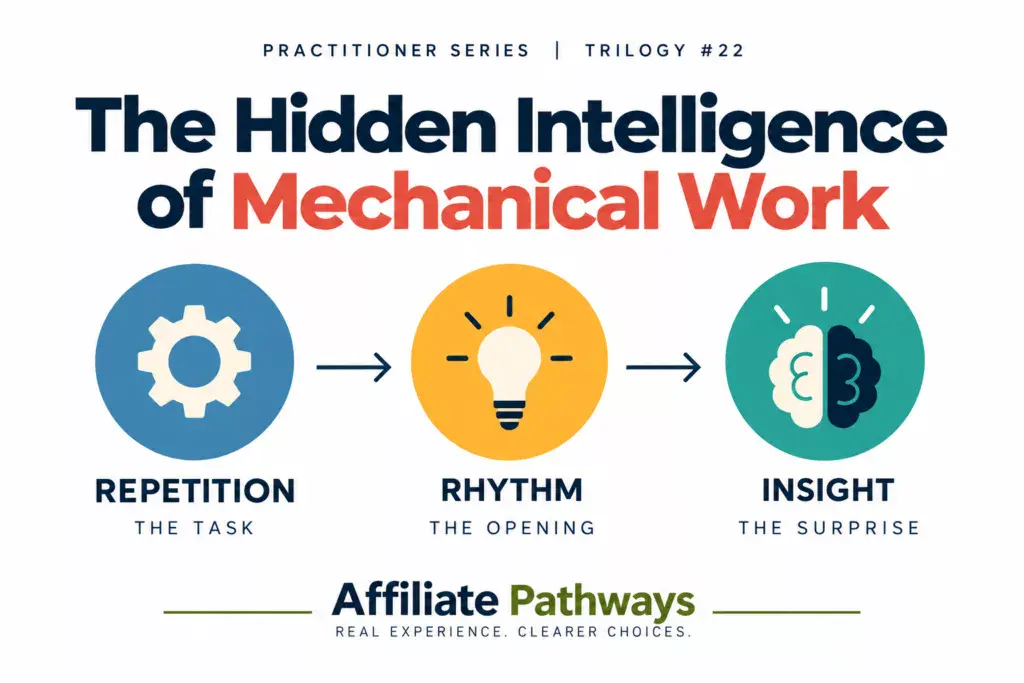
The mechanical creates repetition.
Repetition creates rhythm.
Rhythm can produce absorption.
Absorption can release attention from constant deliberate control.
And occasionally, through that opening:
something new arrives.
Perhaps that is why the traditional hierarchy no longer satisfies me.
The mechanical isn’t necessarily below the cognitive.
The doing isn’t necessarily separate from the thinking.
Sometimes each is part of the condition of the other.
Which Leaves Me With a Different Question
We’re entering an age in which eliminating mechanical work is increasingly treated as an unquestioned good.
And much of it probably should disappear.
But perhaps we need a more discriminating question than:
Can this be automated?
Perhaps we should also ask:
What happens to us while we are doing it?
Does the task merely consume time?
Or does it provide rhythm?
Does it exhaust attention?
Or anchor it?
Does it prevent thought?
Or, strangely enough, create the conditions in which thought begins moving somewhere unexpected?
Because if the latter is sometimes true, then the value of mechanical work cannot be measured only by what sits completed at the end of it.
Sometimes its most interesting product is invisible.
You finish the routine task.
But somewhere along the way, the window opened.
And something you hadn’t gone looking for—
came through.
Want to follow the experiment as it develops?
Ready to Start Your Own Affiliate Marketing Journey?
I’m documenting my own affiliate marketing experiment in real time using the platform below.
Start Your Free Affiliate Journey →
No credit card required. Free starter membership available.