Facebook Ads Experiment Series
This article is part of an ongoing real-world experiment documenting what happens when you run Facebook Ads for affiliate marketing on a small daily budget.
Related articles in this series:
- Can You Run Facebook Ads with $5/Day? A Real Affiliate Marketing Case Study
- The Real Cost of Affiliate Traffic from Facebook Ads (What Most Beginners Miss)
- How to Estimate When Your Facebook Ads Campaign Will Saturate
- Why Facebook Ads Conversions Often Arrive in Bursts (Not Smoothly)
- The First Signal Your Facebook Ads Traffic Is Losing Quality
Introduction
One of the most common questions in paid advertising is simple but difficult to answer:
How long will a campaign continue performing before it stops working?
Most advertisers only realise a campaign has reached saturation after performance has already declined. Costs rise, conversions slow, and the algorithm struggles to find new users.
However, there is a simple signal hidden inside your campaign data that can help you estimate how much audience headroom remains before saturation begins.
The Hidden Ratio: Reach per Conversion
A useful way to monitor audience exhaustion is to look at the relationship between reach and conversion signals.
In this experiment, the conversion signal we track is Wealthy Affiliate CTA clicks.
The formula is straightforward:
Reach ÷ Conversion Signal
In our current campaign the numbers look like this:
Reach: 19,514
WA CTA Clicks: 43
When we divide these values, we get:
19,514 ÷ 43 ≈ 454
This means the algorithm currently needs to show the ad to roughly 454 people to produce one conversion signal.
Where Saturation Typically Begins
Across many Meta campaigns, saturation tends to appear when this ratio increases to roughly:
650–700 people reached per conversion signal
At that point the algorithm has usually already reached most of the high-intent users in the audience.
When this happens you often see three things occur:
- Reach continues increasing
- Conversion signals flatten
- Cost per result rises
In other words, the algorithm is still delivering ads, but it is finding fewer people likely to convert.
Estimating Remaining Headroom
Because the current campaign ratio is approximately 454, there is still a noticeable gap before reaching the typical saturation range.
If we use 675 as a midpoint estimate of the saturation zone, the remaining headroom is approximately:
675 − 454 = 221
This represents the approximate additional “reach-per-conversion” space the campaign may still explore.
Translating Headroom into Time
Campaign reach in this experiment has been expanding by roughly 450–600 people per day.
At that pace, the remaining headroom suggests that the campaign could continue operating efficiently for approximately five to eight more weeks before saturation pressure begins to appear.
Of course, this is only an estimate. Real campaigns can behave differently depending on:
- creative changes
- audience expansion
- algorithm learning
- seasonal demand
But the ratio provides a useful directional signal rather than waiting for performance to deteriorate.
Why This Insight Matters
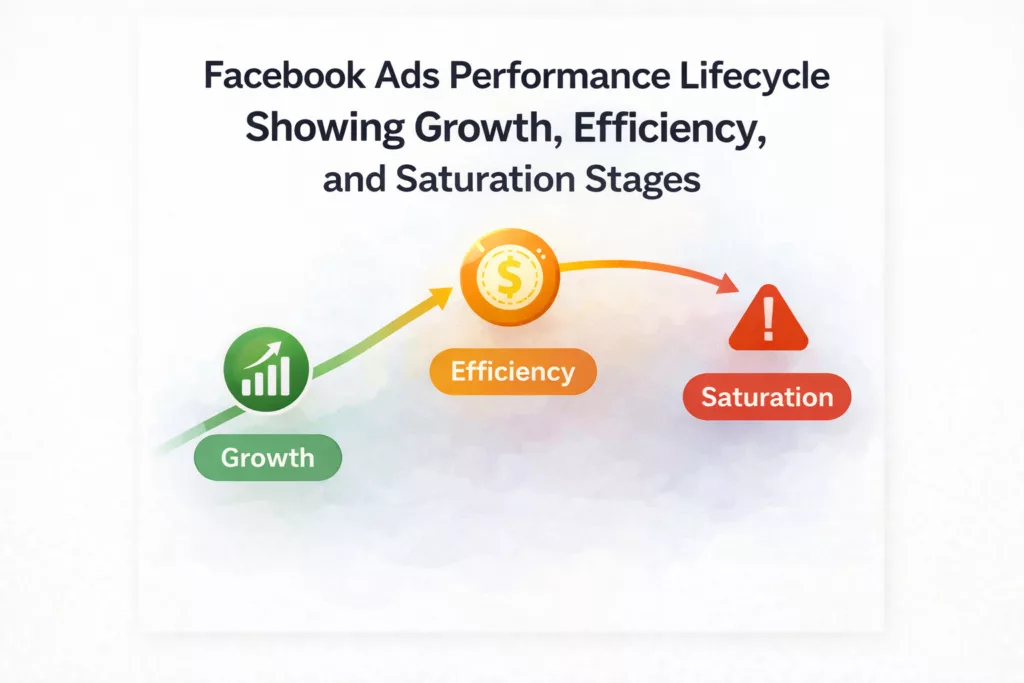
Understanding the reach-per-conversion ratio helps advertisers recognise where a campaign sits within the typical lifecycle:
Discovery → Efficiency → Scaling → Saturation → Expansion
Most beginners only notice the final stage. Monitoring this ratio allows you to anticipate it earlier.
Instead of reacting to declining results, you can prepare the next step in advance — whether that means refreshing creative, expanding audiences, or testing new campaign structures.
Final Thought
Paid advertising rarely stops working suddenly. Performance usually changes gradually as the algorithm exhausts the most responsive parts of the audience.
By tracking the relationship between reach and conversion signals, you can gain a clearer picture of how much room a campaign still has to grow — and when it may be time to start planning the next experiment.
Saturation is only part of the story. The more important warning sign is when traffic quality begins to decline. In the next article, I explain the first signal your Facebook Ads traffic is losing quality.