If your content isn’t structured for conversion, it doesn’t matter how well it ranks — you’re leaving money on the table.
In 2025, affiliate content has to be more than informative. It needs to be easy to scan, build trust fast, and guide readers naturally toward action.
Here’s how top affiliates are structuring their content this year to increase conversions — without sounding salesy.
The difference isn’t more content — it’s better structure.
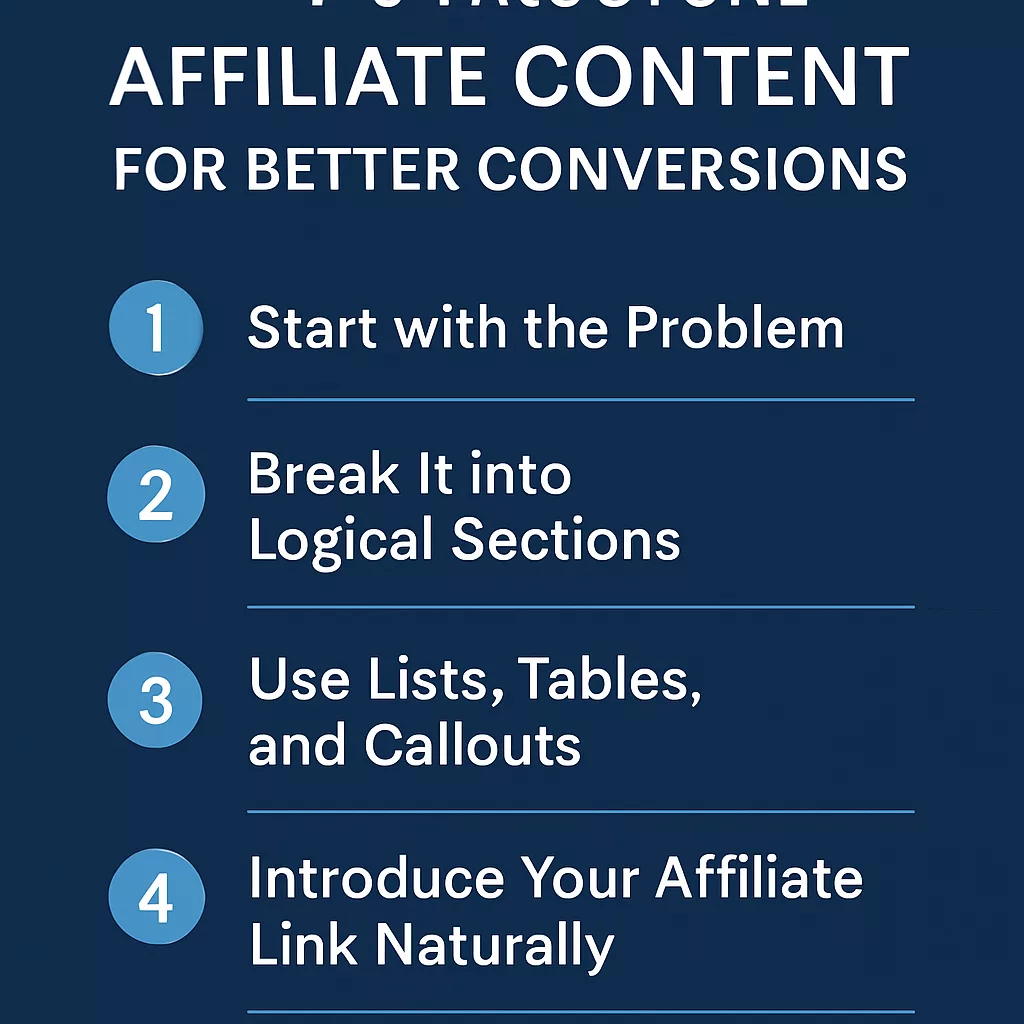
🧭 1. Start with the Problem
When readers feel understood, they keep reading.
Starting with the problem immediately signals relevance. It tells your reader, “You’re in the right place — this is for you.” That emotional alignment builds trust before you ever mention a product or solution.
It also reframes your content from promotion to problem-solving. Instead of pushing offers, you’re guiding readers toward answers — which makes any recommendations that follow feel natural, helpful, and earned.
Most importantly, problem-first content reduces friction. Readers don’t have to work to figure out whether your article applies to them — you’ve already done that work up front.
Before you write anything, ask yourself: ‘What problem is my reader trying to solve?’
When readers recognize themselves in the problem you describe, everything that follows feels relevant — not promotional.
Example:
“If you’re struggling to publish consistent content or rank your site, you’re not alone. But there’s a smarter way — powered by AI tools designed for affiliate marketers.”
2. Match the Solution to the Reader
Not every solution fits every reader — and that’s a good thing. High-converting affiliate content doesn’t try to appeal to everyone. Instead, it helps the right reader recognize immediately whether a recommendation fits their situation, goals, and experience level.
This is where many affiliate posts go wrong. They focus on features, commissions, or hype instead of context. But readers aren’t asking, “Is this good?” They’re asking, “Is this good for me?”
Your job is to answer that question clearly — before they have to ask it themselves.
Who This Works Best For
Not every affiliate strategy works at every stage — and pretending otherwise is where most content loses credibility.
High-converting affiliate content makes it clear who it’s designed for before asking for attention or trust.
This approach works best if you:
- Are a beginner or early-stage affiliate who wants clarity, not complexity
- Prefer long-term trust and consistency over quick wins
- Create content meant to educate, compare, or guide decisions
- Want your recommendations to feel earned, not forced
When readers feel filtered in (or honestly filtered out), trust increases — and conversions follow.
Who This Isn’t For
Just as important as knowing who your content is for is being clear about who it isn’t for.
This approach may not be the best fit if you’re looking for shortcuts, aggressive funnels, or fast wins without audience alignment. It also won’t suit creators who publish thin content purely to chase keywords or commissions.
That’s not a judgment — it’s a boundary. Clear boundaries protect your reader’s expectations and your credibility at the same time.
🧱 3. Break It into Logical Sections (with H2s)
Once you’re clear on fit, structure becomes the lever that turns good content into content that converts.
Logical sections help readers move through your argument without friction. They signal what matters, what comes next, and when it’s time to slow down or move on — all without requiring conscious effort.
Readers don’t read affiliate content line by line. They scan first, then decide whether to continue based on structure. Clear sectioning reduces cognitive load and builds trust before you ever ask for attention or action.
Each major section heading should answer one clear question the reader is asking at that moment. If it doesn’t, it’s probably in the wrong place — or unnecessary.
Effective H2s tend to:
- Reflect a single decision or concern
- Use plain language rather than clever phrasing
- Progress logically from problem → understanding → action
- Match the reader’s current stage of awareness
For example, compare a heading like “Affiliate Program Options” with “How to Choose an Affiliate Program That Fits Your Audience.”
The second tells the reader exactly what they’ll get — and why it matters now.
Once your structure reflects how readers actually think, tools like lists, tables, and callouts start working for you instead of cluttering the page.
📝 4. Use Lists, Tables, and Callouts
Structural elements like lists, tables, and callouts are powerful — but only when they’re used intentionally. Overused, they fragment attention and make content feel busy. Used well, they reduce effort and help readers make decisions faster.
Lists work best when the reader is comparing, filtering, or checking for fit. They allow quick scanning without forcing readers to parse dense paragraphs. Tables are most useful when you’re comparing a small number of options across consistent criteria — not when you’re trying to impress with volume.
Callouts serve a different role. They’re best reserved for moments where you want to pause the reader and reinforce something important: a warning, a takeaway, or a decision rule. When everything is highlighted, nothing stands out.
A simple test helps here: if removing a list, table, or callout would not reduce clarity, it probably doesn’t belong. Structure should make your thinking easier to follow — not compete with it.
Used selectively, these tools support your message. Used indiscriminately, they dilute it.
🤝 5. Guide Readers Toward Action — Without Forcing It
Never lead with the pitch. Your affiliate link should feel like a helpful recommendation, not a sales tactic.
What to do:
- Frame the link as a solution, not a transaction
- Use anchor text that explains the benefit
- Place links mid-content and at the end, but not in every paragraph
Example:
Effective affiliate content doesn’t push readers toward action — it leads them there.
By the time you make a recommendation, the reader should already understand the problem, feel aligned with the solution, and trust the way you’ve framed the decision. At that point, action feels like a natural next step — not a sales pitch.
This is why placement matters. Calls to action work best when they appear after clarity, not before it. Dropping links too early interrupts trust-building and signals self-interest. Waiting until the reader has context signals patience and credibility.
Language matters just as much as timing. Instead of telling readers what they “should” do, frame recommendations as options: tools to explore, platforms to evaluate, next steps to consider. This keeps agency with the reader — and paradoxically increases follow-through.
A useful rule of thumb is this: if your recommendation feels helpful even to someone who doesn’t click it, you’ve placed it correctly.
When structure, fit, and timing are right, conversion becomes a byproduct of good guidance — not something you have to chase.
🎯 6. Close with a Clear CTA
A strong call to action doesn’t pressure the reader — it gives them a clear way forward.
By the time someone reaches the end of your post, they’ve already done the hard work. They’ve understood the problem, evaluated the context, and followed your reasoning. The role of the CTA is simply to acknowledge that momentum and offer a sensible next step.
That step doesn’t need to be aggressive or urgent. In fact, the most effective CTAs are often the quietest ones: an invitation to explore further, test a tool you’ve already discussed, or deepen understanding with a relevant resource.
What matters is alignment. The action you suggest should feel like a natural extension of the guidance you’ve just provided — not a pivot into selling.
A useful test is this: if a reader doesn’t click your CTA, does the recommendation still feel helpful and complete? If the answer is yes, you’ve placed it correctly.
When clarity comes first and action comes last, conversion stops feeling like an objective — and starts happening as a byproduct of trust.Every post should end with a compelling Call to Action — even if it’s just a soft prompt.
🔗 Internal Reads You’ll Find Useful:
- What Is High-Quality Content? (2025 Guide)
- 3 Strategies to Build Trust in Affiliate Marketing
- Top Affiliate Niches to Focus on in 2025
If you want a clear framework for evaluating affiliate programs before you build content around them, I break that process down step by step in How to Choose the Right Affiliate Program in 2025 — including what to prioritise, what to avoid, and how to match programs to content that actually converts.
📣 Want to Learn How to Structure Affiliate Content Like a Pro?
💡 Ready to Start Your Affiliate Marketing Journey?
Get expert training, tools, and support to build a real online business — even if you’re starting from scratch.
Final Thoughts
The structure of your content determines whether people read it — and whether they trust you enough to click.
Make it skimmable, human, and helpful. Focus on solving a real problem, and let your affiliate link flow from that — not the other way around.
Good structure = higher conversions. Simple as that.