Why Facebook Ads Conversions Often Arrive in Bursts (Not Smoothly)
March 17, 2026 by admin
Facebook Ads Experiment Series
This article is part of an ongoing real-world experiment documenting what happens when you run Facebook Ads for affiliate marketing on a small daily budget.
Related Articles in This Experiment
If you’re following this real campaign step-by-step, these articles will help you understand each stage:
• Can You Run Facebook Ads with $5/Day? A Real Affiliate Marketing Case Study
(See how the experiment started and what results are possible on a small budget)
• The Real Cost of Affiliate Traffic from Facebook Ads (What Most Beginners Miss)
(Understand why traffic alone doesn’t equal profit)
• How to Estimate When Your Facebook Ads Campaign Will Saturate
(Understand how long your campaign can realistically perform before efficiency declines)
• The First Signal Your Facebook Ads Traffic Is Losing Quality
(Identify early warning signs before performance drops)
Introduction
One of the most confusing aspects of running Facebook Ads is how inconsistent the results can feel.
Some days you see multiple conversions. Other days, nothing happens at all.
For beginners, this often feels like something is broken.
But in most cases, this pattern is completely normal.
For a deeper understanding of how Facebook ad performance evolves over time, see our guide:
How to Estimate When Your Facebook Ads Campaign Will Saturate
The Illusion of Inconsistency
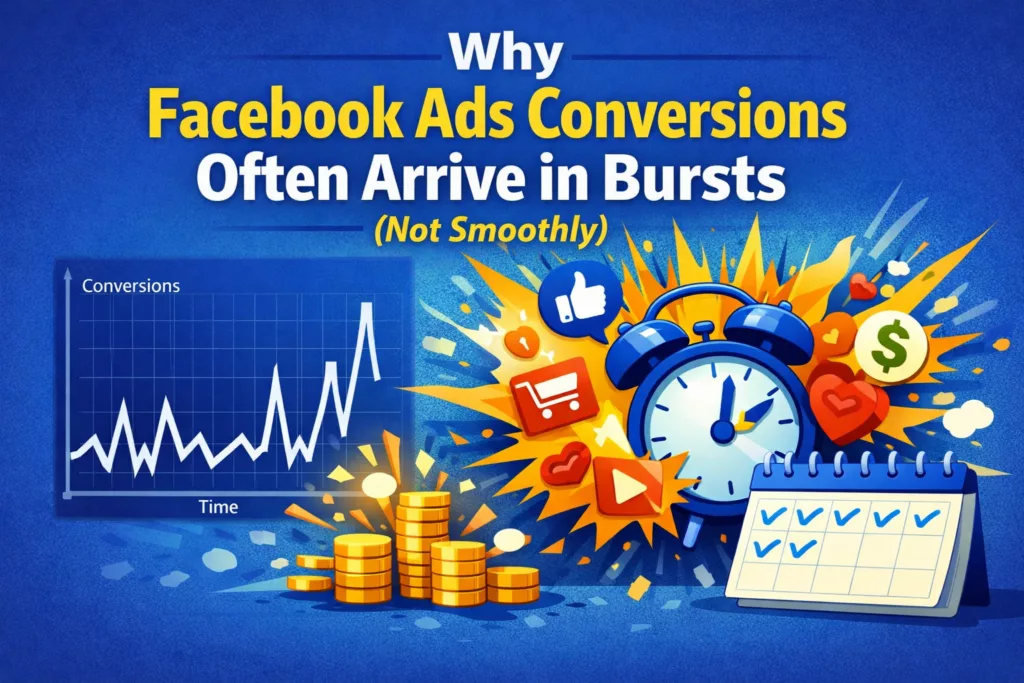
At first glance, conversions appear random.
You might see:
- A spike in clicks or conversions on one day
- Followed by a quiet period
- Then another sudden increase
This creates the impression that the campaign is unstable.
But what you’re actually seeing is the natural outcome of how the algorithm delivers ads.
How the Algorithm Distributes Opportunity
Facebook does not distribute your ads evenly across time.
Instead, it delivers ads based on:
- auction opportunities
- user behaviour patterns
- predicted likelihood of engagement
This means your ads are more likely to be shown when higher-intent users are active.
When multiple high-intent users see your ad within a short window, conversions appear to arrive in clusters.
Why Conversions Cluster Together
Conversions are not evenly spaced events.
They are influenced by:
- timing (when users are online)
- intent (how ready they are to act)
- context (what else is competing for attention)
As a result, even a well-performing campaign can produce:
- several conversions in one period
- followed by a gap with no activity
This is not necessarily a sign of declining performance.
When “Bursts” Become a Problem
While clustered conversions are normal, there is a point where they can signal a deeper issue.
If bursts become:
- less frequent
- smaller in size
- followed by longer gaps
it may indicate that the campaign is beginning to lose efficiency.
If your results feel inconsistent, it may also be a sign your traffic quality is changing. See:
The First Signal Your Facebook Ads Traffic Is Losing Quality
The Role of Sample Size
Small budgets amplify this effect.
In a campaign running on $5 per day:
- fewer impressions are generated
- fewer conversion opportunities exist
This makes results appear more volatile than they actually are.
Larger campaigns tend to smooth out this pattern because they generate more data.
What This Means for Decision-Making
Understanding this behaviour changes how you evaluate your campaign.
Instead of reacting to daily fluctuations, you begin to:
- look at trends over several days
- focus on averages rather than individual results
- avoid making premature changes
This leads to more stable and informed decisions.
From Behaviour to Strategy
Once you recognise that conversions arrive in bursts, you can adjust your expectations.
This reduces unnecessary changes that can disrupt the algorithm.
It also allows you to focus on the more important questions:
- Is performance improving over time?
- Is cost per result stable?
- Is the campaign moving toward profitability?
Want to Turn Traffic Into Actual Affiliate Income?
Running ads is only part of the equation. The real challenge is turning that traffic into consistent commissions.
If you’re starting out or want a structured roadmap, this free plan walks you through the exact steps:
👉 Get Your Free Affiliate Business Plan
It’s designed specifically for beginners using strategies like the ones in this experiment.
Final Thought
Facebook Ads rarely behave in a smooth, predictable way — especially at smaller budgets.
What looks like inconsistency is often just the natural rhythm of how the algorithm finds and delivers opportunities.
By understanding this pattern, you can avoid unnecessary adjustments and focus on what actually matters: long-term performance trends.
Categories: Affiliate Marketing Experiments, Meta Ads Campaign Analysis